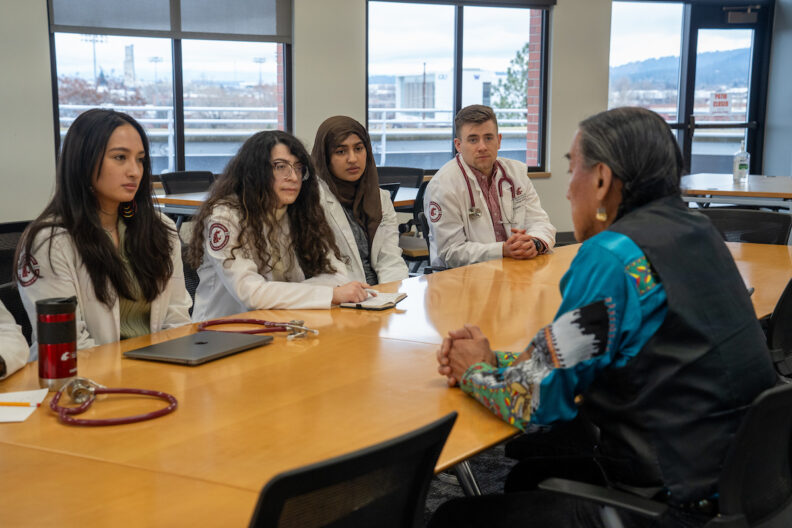
A unique project, facilitated by WSU’s Native Health Sciences (NAHS) program, invites Native American community members to share their healthcare experiences to help train future healthcare providers to deliver more respectful, culturally safe, and effective care.
The program seeks personal stories that illustrate both challenges and moments of exceptional care for use in NAHS’s healthcare simulation education curriculum, which will train both WSU healthcare students as well as practicing providers.
In a survey conducted in 2020, “about 1 in 5 rural Native Americans (19%) reported experiencing racial discrimination when going to a doctor or health clinic,” and another “14% reported avoiding seeking needed health care due to fear of unfair treatment.” These experiences and perceptions can impact patient health outcomes and overall quality of life.
“Many Native American patients have experienced care that felt dismissive, disrespectful, or unsafe,” said Jerry Crowshoe, director of NAHS. “These stories are a key part of helping students learn from real experiences and improve the quality of care for Native communities. The utilization of stories helps immerse the learner in the oral system, which honors the old ways of transferring knowledge in a culturally grounded simulation experience.”
Healthcare simulation education offers hands-on and experiential learning opportunities for learners at all levels, enabling them to learn and apply best practices in a safe and supportive setting. The NAHS simulation curriculum, currently under development, seeks to highlight barriers to culturally responsive care and contribute to long-term improvements in healthcare for Native communities.
Those interested in participating can submit their information via a form on the NAHS website. If selected, participants will have the opportunity to share their experiences in a video-recorded interview and will receive an honorarium for their time and expertise. Travel support is also available if needed. The recordings will only be used for training purposes and will not be shared with the wider public.
“We recognize that there can be a lot of emotional and cultural labor involved in sharing sensitive personal stories,” said Crowshoe. “However, we know that these challenging experiences can help healthcare providers better serve Native patients and families.”
